The Minister of Finance and Development Planning, Dr. Retselisitsoe Matlanyane, emphasised that building economic resilience is no longer optional but the central organising principle guiding government policy priorities for the coming financial year.
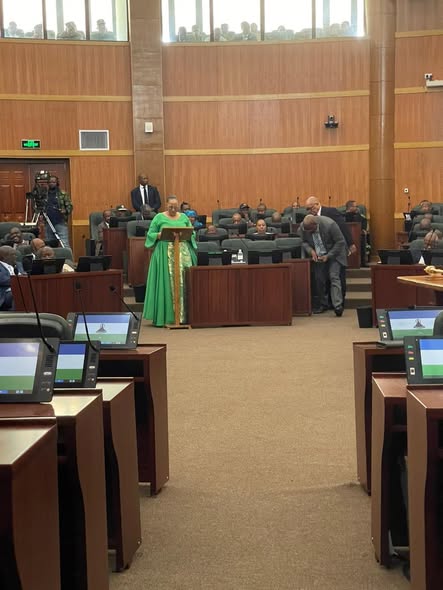
Dr. Matlanyane made the remarks during the presentation of the 2026/27 national budget at the National Assembly.
The session was attended by the Prime Minister, Members of National Assembly, Senators, development partners, senior government officials and members of the media.
She noted that Lesotho can no longer rely on episodic growth, preferential market access or external financing to sustain jobs and public services.
Instead, resilience must be deliberately built through stronger economic growth, enhanced domestic revenue mobilisation, sound public financial management and institutions capable of executing policy with speed and precision. The Minister stated that fiscal policy remains the central instrument and anchor for restoring investor confidence, strengthening social protection and enabling private sector-led growth.
She further stressed that it is time for Lesotho to fully utilise its available resources: water, diamonds, solar energy and human capital to drive development and sustainability. She said all sectors must work together to achieve this goal. “We have to use the money that we have for the development of our country and enhancing economic growth as well as sustainability,” she said.
Dr. Matlanyane reported that the government’s total debt stock as at the end of January in the 2025/26 financial year stood at M22.7 billion, equivalent to 50 per cent of GDP. This reflects a decline of M667.2 million from M23.4 billion recorded at the end of the 2024/25 financial year, representing a three per cent reduction in debt stock.
Consequently, the debt-to-GDP ratio fell from 54.3 per cent to 50 per cent. She indicated that the composition of public debt also shifted during the period, with the share of domestic debt increasing from 15.4 per cent to 16.9 per cent, while external debt declined from 84.6 per cent to 83.1 percent.
The Minister emphasised that the country’s debt risk rating remains unchanged from the 2024/25 fiscal year at a moderate level of debt distress, with limited space to absorb shocks. Dr. Matlanyane said the macroeconomic outlook compels a deliberate shift in policy priorities towards strengthening domestic revenue mobilisation, enforcing disciplined and efficient expenditure, and restoring credibility in policy execution.
She reiterated the government’s commitment to maintaining a sustainable fiscal path, warning that heavy reliance on Southern African Customs Union (SACU) transfers projected to stabilise at around 20 percent of GDP poses a major macro-fiscal vulnerability, particularly in light of economic performance in South Africa and regional trade dynamics.
She further highlighted that external trade shocks, including new tariffs on apparel exports and weaknesses in the global diamond market, threaten domestic revenue and reserve buffers.
The Minister noted that trade barriers and protectionist policies undermine investor confidence and long-term planning in vulnerable, trade-dependent economies.
She said in Lesotho the textile and apparel industry is the largest private sector employer and the cornerstone of the country’s export base is particularly affected. “What was once our comparative advantage anchored by preferential access to one of the largest markets has now become a structural vulnerability.
International buyers are actively de-risking their supply chains, diverting orders away from smaller economies such as ours,” she said. She added that this has resulted in factory closures, large-scale job losses and increased pressure on household incomes.
The erosion of the industrial base, she warned, poses long-term risks not only to employment but also to skills retention, foreign exchange earnings and social stability. Meanwhile, Members of the House adopted the 2026/27 budget.
Source: Lesotho News Agency [LENA]