Your Excellencies, Heads of State and Government
Distinguished guests,
Ladies and gentlemen,
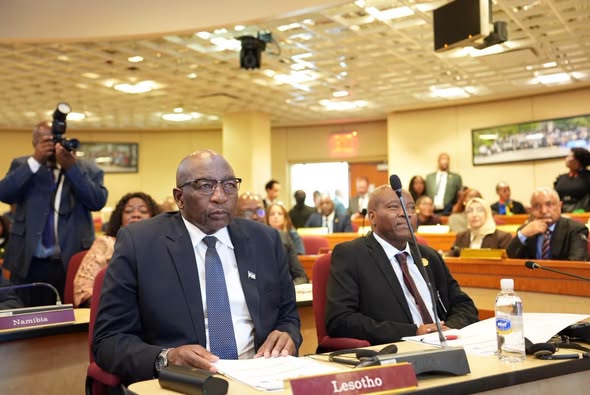
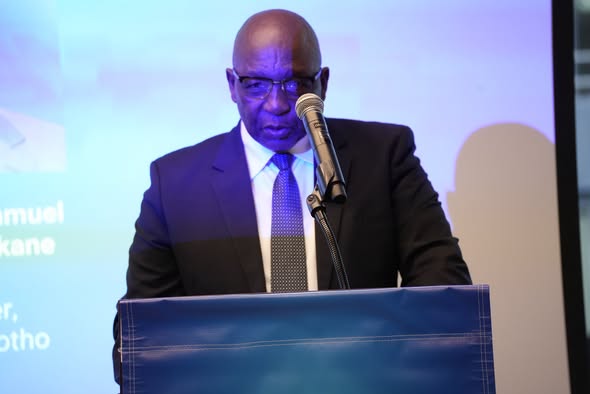
It is my honour to open the first substantive session of this Digital Cooperation Day: Introducing the AI Strategy Blueprint: Turning National Ambition into Action.
Artificial intelligence is spreading faster than any general-purpose technology in history. Lesotho welcomes its potential. We are not a country that fears AI. We are a country determined to use it wisely, responsibly and urgently to advance sustainable development.
Yet technology alone does not create development. Infrastructure, institutions, skills, governance and investment determine whether AI expands opportunity or deepens existing inequalities.
It is in this context that Lesotho became the first country to apply the United Nations Blueprint for National AI Strategies.
Today, I would like to share three messages.
First, our journey began with a candid assessment of our readiness to govern and harness AI.
Second, we found the Blueprint practical and valuable. It validated the choices we had already begun to make while providing a clear framework for action.
Third, we have moved beyond strategy into implementation. Working with the United Nations Office for Digital and Emerging Technologies, the Office of the UN Resident Coordinator, and other partners across the UN system, we are now advancing Phase One of our National Compute Roadmap. We welcome all partners who wish to join us on this journey.
Over the past year, the Government of Lesotho, led by the Ministry of Information, Communications, Science, Technology and Innovation, undertook a comprehensive assessment of our readiness for AI.
The process highlighted areas where we must strengthen national capability, including digital infrastructure, compute capacity, data governance, institutional arrangements, skills development and sustainable financing.
These findings were reinforced through our participation in the inaugural United Nations Global Dialogue on AI Governance in Geneva. A clear message emerged: the AI divide is no longer defined by access alone. It is increasingly shaped by whether countries possess the compute, data, skills and institutions needed to govern and benefit from AI.
Lesotho has chosen to address that challenge proactively. Through our readiness assessment, the AI Strategy Blueprint and the Data Centre Blueprint, we are translating global discussions into practical national action, positioning ourselves not merely as consumers of AI technologies, but as active participants in shaping their impact.
We did not begin from zero.
Lesotho entered this process with three validated digital policies, an operational government data centre and a designated Chief Digital Office. We had already identified critical investment needs across infrastructure, compute, data governance, skills, institutional capacity and financing.
Like many countries, we have a data centre. But possessing a data centre is not the same as being prepared for AI.
The Blueprint helped us answer a fundamental question: how do we develop the digital infrastructure required for our AI ambitions while working within real constraints of energy, water, financing, human capacity and geography?
Its value was not in replacing our plans, but in strengthening them. It confirmed that we were moving in the right direction and helped us sequence our decisions more effectively.
The process began with the policies already in place. We then focused on identifying the services that matter most to our people. Only after defining those services can we determine the infrastructure needed to deliver them.
Every investment in digital infrastructure must be justified by tangible improvements in people’s lives, whether in agriculture, health, education, water management or public administration.
This is an important lesson. Infrastructure should follow demand, not precede it. Our objective is not to replicate the models of larger economies but to build capacity that reflects our resources, priorities and development needs.
For Lesotho, digital infrastructure must never become a monument to technological ambition. It must become a foundation for national capability.
The true test of any strategy is implementation.
With support from the UN Resident Coordinator’s Office, the United Nations Office for Digital and Emerging Technologies, the Global AI Capacity Development Network, UNDP, UNICEF, UNESCO and ITU, Lesotho recently completed a five-day working session in Maseru.
This was not a conference. It was a practical exercise in turning strategy into action.
The outcome was a roadmap supported by five concrete actions, each assigned to responsible institutions and clear timelines. The Minister will elaborate on these further during the panel discussion.
What we are building is not simply infrastructure. We are building the national capability that surrounds it: the ability to govern data responsibly, deploy AI safely, deliver better public services and create new opportunities for innovation and economic growth.
There is another important lesson from our experience.
International partnerships are among the greatest assets available to developing countries. Yet support often arrives through separate channels, with different priorities and timelines.
What made this initiative different was that the United Nations came together as one.
Through the coordination of the UN Resident Coordinator, expertise from across the UN system was aligned around priorities identified by Lesotho itself.
The Blueprint provided a common framework through which partners could coordinate support around a shared understanding of national needs.
This may be one of the most valuable lessons from our experience. The Blueprint is not only a tool for technology planning. It is also a tool for coordination, enabling governments and partners to work from the same picture and move toward the same objectives. It truly puts Government in the driving seat.
I wish to express my sincere appreciation to the United Nations Office for Digital and Emerging Technologies for selecting Lesotho as the first country to apply the Blueprint and for supporting us throughout this process.
I also thank the Executive Office of the Secretary-General, the Office of the UN Resident Coordinator in Lesotho, ITU, UNESCO, UNICEF, UNDP, the Global AI Capacity Development Network, and the Governments of Ethiopia and Senegal for sharing valuable expertise and practical lessons.
Their support demonstrates the power of collaboration in building the capabilities required for the AI era.
Lesotho is the first country to apply the Blueprint for National AI Strategies.
As a result, we now have a roadmap we trust, a clear sequence of priorities and a practical path from ambition to implementation.
The design phase is behind us.
We are now implementing Phase One of our National Compute Roadmap for 2026-2029 with clear objectives, accountable institutions and a commitment to building lasting national capability.
Partnership is not a substitute for national ownership. For countries like Lesotho, it is one of the ways national ownership is strengthened.
That is the spirit in which we move forward.
And so I conclude with a simple invitation: as Lesotho moves from planning to implementation, we welcome partners who wish to join us in building an inclusive, responsible and development-focused digital future.
The door is open.
Thank you.
Source: Department of Information!! 22/9/2026