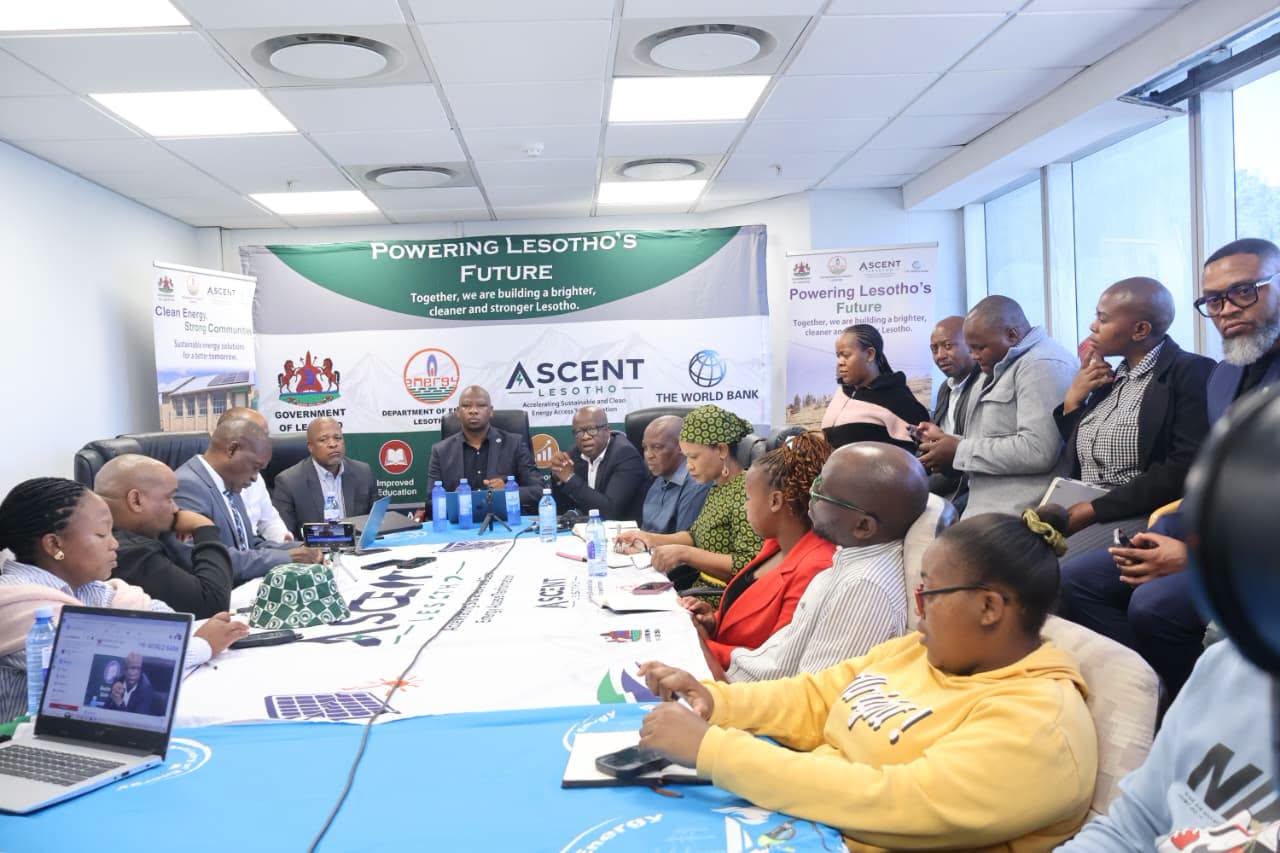
The Government of Lesotho has set a target to ensure that all Basotho have access to electricity by 2030 through the implementation of the Mission 300 and Accelerating Sustainable and Clean Energy Access Transformation ( ASCENT) programme in Lesotho.
Speaking at the press briefing, Minister of Energy and Mining Mr. Lejone Mpotjoane said the ministry has a mandate to ensure that all Basotho households are connected to electricity, adding that the government is working towards achieving universal electricity access.
He said the target will be achieved through grid extension, mini-grids or solar home systems, with the programme expected to benefit about 14,000 households. He added that the ministry will conduct a survey to establish the number of people who remain without electricity, in addition to those already identified through previous surveys.
The minister said Mission 300 was launched in Thaba-Tseka, with the programme expected to cover Thaba-Tseka, Qacha’s Nek, Quthing, Mohale’s Hoek, Mafeteng, Berea, Leribe and Butha-Buthe.
He said the programme , which has about M800 million will run for four years and is part of efforts to connect communities across the country by 2030.
Mr. Mpotjoane said the government has also introduced Category D under the Lesotho Electricity Company (LEC), specifically targeting young people below the age of 35 with electrical qualifications and related skills.
He said the initiative is aimed at creating economic opportunities for young people while ensuring that safety standards are maintained.
He explained that Category D contractors will be given low-risk jobs that can be supervised and inspected by LEC, including connecting meters, while major works such as constructing electricity networks and substations will remain the responsibility of higher categories.
The minister said the initiative will also create employment opportunities for people without specialised electrical skills, who can, for example, be employed to dig holes for electricity poles.
He mentioned that the government has recognised the high level of youth unemployment and is therefore seeking ways to use the electricity sector to create opportunities for young people.
Mr .Mpotjoane stated that Lesotho currently produces about 50 percent of the electricity it consumes adding that the ministry is looking at increasing local generation capacity.
The minister said the Mission 300 programme followed research conducted by the African Union and was aimed at connecting at least 300 million people to electricity across Africa by 2030.
He said increased electricity access will contribute significantly to the development of schools, hospitals and communities, while also creating employment and supporting economic growth.
The programme forms part of Lesotho’s efforts to achieve universal electricity access by 2030 by expanding electricity infrastructure and connecting communities that are still without reliable access to power.
Source: Lesotho News Agency [LENA]