The government will ensure that every Loti returned to Lesotho through the Lesotho Highlands Water Project (LHWP) is invested wisely, in health, education, infrastructure and in the future of young people.
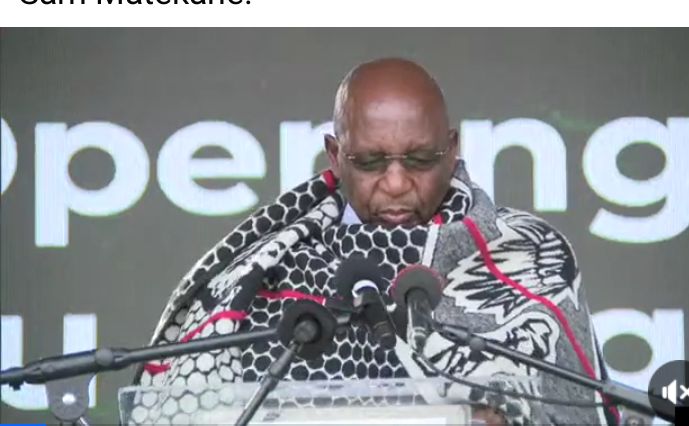
The Prime Minister, Mr. Ntsokoane Matekane said this when delivering his remarks on behalf of the Lesotho government at the official opening of the Senqu bridge in Mokhotlong which was officially opened by King Letsie 111 and South Africa President Cyril Ramaphosa.
Mr. Matekane said the Lesotho government has directed Lesotho Highlands Development Authority (LHDA) to honour its resettlement and livelihoods restoration commitment on time and in full to people affected by the implementation of the project.
He stated that the LHWP Treaty and the International best practice require that the standards of living for the affected communities be improved and should be experienced by communities themselves.
He called upon all stakeholders to work tirelessly and ensure that communities are not left vulnerable as a result of this project.
The PM further said the LHWP must not only be recognized globally for engineering excellence such as the Senqu bridge but it must shine in the areas of social development, environmental stewardships, livelihoods restoration and public health, to make meaningful impacts to both countries.
Mr. Matekane further said Lesotho Constitution, LHWP Treaty and LHDA Order of 1986 provide a legal framework for the protection and promotion of the rights of affected people and their rights include the right to development of their living conditions.
“We will continue to monitor compliance and hold implementing authorities accountable through the project legal instruments and other innovative means,” he said.
The PM stated that the construction of Senqu bridge and the other two namely Khubelu and Mabunyaneng are not conversions but obligations under Phase II which should be delivered as commitment towards maintaining connectivity.
Since the aforementioned bridges are the first of many yet to be built, he urged the project to ensure that affected communities participate in the identification of bridge locations.
He expressed gratitude to President Ramaphosa and the government of South Africa for the partnership which remains a cornerstone of this project saying the LHWP Treaty stands as one of the Africa most successful bi-national development agreements, 40 years now, and look forward to many fruitful agreements in future.
Giving the project overview at the same occasion, the LHDA Chief Executive Mr. Tente Tente said this year marked 40 years of the treaty signing, which has indeed ushered in the successful partnership between the two countries, Lesotho and South Africa.
He said one of the treaty objectives is the desire for the improvement of livelihoods, promotion of traditional and good neighbourly relations, regional peace, prosperity and cooperation as well as equitable sharing of water resources.
He cleared some of the misconceptions regarding the Treaty saying its review is captured under Article 18 of the Treaty where 18.1 says the treaty shall be reviewed at intervals of 12 years or such intervals as may be agreed by the parties.
He stated also that the treaty may be amended at any time agreed by both parties.
He said the Treaty started in 1986, and in 1998 negotiations started and completed in 1999 and led to what was called Protocol 6 which addressed systems of governments.
“In 2011, Phase II agreement came into place, and 12 years later, (in 2023) discussions around treaty review started but it happened that the current government was just settling in at that time,” he said.
Another misconception Mr. Tente cleared was the issue around sale of water. He clarified that the Treaty talks about Royalties not the sale of water and delivery of water quantity to South Africa.
Speaking at the same occasion was the Principal Chief of Mokhotlong Chief Lerotholi Mathealira Seeiso who appreciated the development of the bridge implemented in Mokhotlong.
He appealed to the LHDA to have a livelihoods restoration master plan to ensure the living conditions of affected people improve.
Senqu Bridge is one of the major components implemented under the Lesotho Highlands Water Project Phase II. It is the longest bridge in Lesotho at 825 metres with the highest pier (pillar) standing at 90 metres.
Its construction started in 2022 and completed earlier this year. LHDA awarded a M2 billion contract to WRES joint venture, a consortium of different companies from South Africa, Lesotho and other nations, responsible for the engineering and construction of the bridge.
It has been designed to connect Mokhotlong town across the reservoir to maintain road connectivity and support economic activity in the district.
About 1,200 people, mostly Basotho, benefited from the bridge construction by being employed.
Source: Lesotho News Agency [LENA]