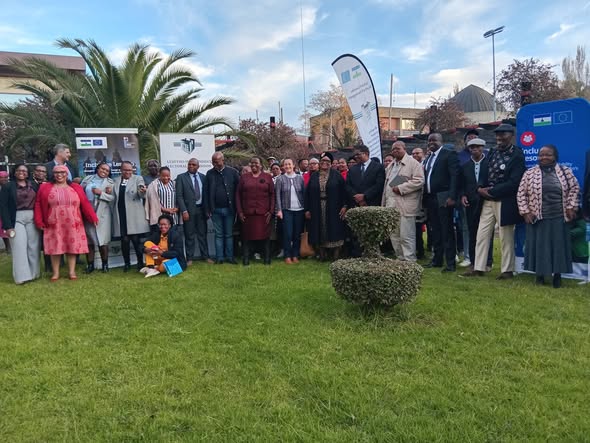
The Lesotho Independent Electoral Commission (IEC) officially launched its Civic and Voter Education Strategy and Voter Registration programme in Maseru to boost civic awareness and ensure informed participation ahead of the country’s upcoming electoral processes.
In his opening remarks, Reverend Dr. John Maphephe described the signing and launching of the two documents as a significant step for Lesotho’s democracy.
He said the strategy and registration programme are critical instruments meant to reach citizens directly, noting they should serve as practical tools for public participation rather than remain technical documents for officials alone.
The launch brought together government, civil society, development partners and media to align on messaging and outreach before registration begins.
Principal Secretary of Home Affairs, Mabataung Khalane, said the signing of the strategy represents more than a routine achievement.
“It is a profound commitment to strengthening the credibility, inclusiveness and trustworthiness of our electoral process,” she said.
Khalane noted the Ministry of Home Affairs holds sole responsibility for maintaining the National Population Register and issuing legal identity documents.
“Today we are furthering our commitment as the country prepares for the national identity document to serve as the sole document required for voter registration. This ensures that every citizen can participate in a trusted and secure system,” she said.
She added that the IEC’s comprehensive voter registry roadmap depends on the Ministry keeping the population register updated, accurate and accessible.
“By fulfilling this mandate, we enable the IEC to deliver a voter register that reflects the people and strengthens confidence in our democratic institutions,” he said.
Acting IEC Director, Mrs. Lydia Macheli said the Commission will roll out passive and continuous registration in collaboration with the National Identity and Civil Registry (NICR).
“We are working on legal and institutional reforms, proposing amendments to the National Assembly Electoral Act of 2011 to address stakeholder concerns around registration,” she said.
Macheli stressed capacity building and technology are central, “We cannot register voters if we are not capacitated. ICT systems are involved to produce a clean register,” he said.
Expected outcomes include an accurate and inclusive voters’ register that covers people with disabilities, improved IEC operational efficiency, and better institutional coordination.
Key recommendations include using the National ID as the primary registration document, expanding technology, enhancing public engagement and ensuring sustainable funding.
Head of Cooperation at the European Union, Ms. Anna Renieri said the strategy is the backbone to strengthen democracy and address key challenges.
“This program is for an inclusive Lesotho so everyone can participate in the country’s democracy,” she said.
“Civic and voter education are the heart of democracy. Democracy does not begin at the ballot box , it begins long before, when a young person learns about rights and responsibilities,when a woman in a rural area can register easily and safely and when people with disabilities get registration and information accessible,” Mario Giuseppe Varrenti said.
Thabo Mosoeunyane described the launch as a demonstration of commitment by the IEC, Home Affairs and development partners.
“Partnership is what matters most,” he said, noting that EU election observation missions had previously identified gaps, including a faulty voters’ roll.
The strategy sets out targeted outreach to youth, first-time voters, rural communities, women, and persons with disabilities. IEC said the goal is to ensure no eligible citizen is left behind and that every voice is heard in shaping Lesotho’s future.
Source: Lesotho News Agency [LENA]