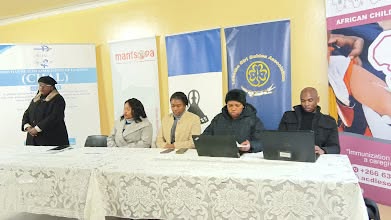
As Lesotho approaches its 60th independence anniversary, the Immunisation Network of Civil Society Organisations Lesotho (INCL) emphasizes that vaccination is much more than a medical service. It is a vital investment in the nation’s future and must be treated as a core national priority.
INCL Chairperson, Ms. Puseletso Nthunya said this during the launch of the Independence Immunization Campaign where she said every vaccinated child represents a healthier family, a stronger community and a more productive nation.
She said the campaign seeks to mobilize national support and encourage collective responsibility for immunization financing, advocacy and service uptake.
She said it also aims to bring together stakeholders from all sectors to champion sustainable investments that will protect future generations and strengthen the country’s health system.
She said achieving high and equitable immunization coverage requires collaboration among government, civil society, development partners, faith-based organizations, the private sector, traditional leaders, the media and communities themselves.
“Through advocacy, social mobilization, resource mobilization and community engagement, CSOs can help Lesotho achieve its vision of reaching every child with life-saving vaccines and ensuring that no child is left behind,” she said.
Ms. Nthunya stated that while vaccines are available through the national immunization programme, several barriers continue to affect uptake and coverage citing that many communities in Lesotho are in mountainous and remote areas where access to health facilities is difficult, particularly during adverse weather conditions which can result in missed vaccination opportunities and delayed immunization schedules.
She highlighted vaccine hesitancy and misconceptions about vaccines as another barrier saying this limits access to accurate health information and discourage caregivers from vaccinating their children. She said vaccine confidence remains an important area requiring continuous community engagement.
She added that limited community awareness, zero dose and defaulter children as well as socio-economic problems including poverty, unemployment and food security also hinder access to vaccines.
Moreover, she noted that civil society groups act as an extension of the formal health system, bridging gaps in remote mountain areas and marginalized communities. She said these grassroots networks help dismantle barriers such as language or disability stigma, ensuring no family is left behind.
Ms. Nthunya indicated that as INCL, firmly believes that protecting children through immunization is a shared national responsibility. She said through strong partnerships, resource mobilization and coordinated advocacy, Lesotho can continue to expand immunization coverage and reach underserved communities.
She therefore called upon government institutions, development partners, the private sector, civil society, faith-based organizations, academic institutions, the media and all Basotho to join hands with the Network in supporting this campaign and its activities.
On the other hand, Mr. Rorisang Mpale said as CSOs they are entrusted to penetrate villages and ensure full accessibility of vaccines.
He said another barrier contributing to defaulting and zero dose is language used in medical booklets saying caregivers are not able to interpret as vaccines are written in English.
He added that traditional healers should also be sensitized about vaccines so that they understand their importance and help in advocating for vaccination.
Meanwhile, the establishment of INCL traces back to September 2024, following a Gavi-supported training workshop held in Thaba-Bosiu. Since then, the Network has grown into a coalition of over 30 local Civil Society Organizations under the leadership of the Christian Health Association of Lesotho (CHAL), committed to promoting equitable access to vaccines, strengthening community engagement and supporting national immunization efforts.
The formation of the Network was informed by the recognition that sustainable immunization coverage cannot rely solely on health facility-based services. It requires strong community-driven systems that promote vaccine awareness, generate demand, address barriers to access, and ensure that every eligible child receives life-saving vaccines.
Source: Lesotho News Agency [LENA]